How Much Does It Really Cost to Own a Car in Lagos in 2026?
How Much Does It Really Cost to Own a Car in Lagos in 2026? Buying a car in Lagos can feel like a major achievement.
You finally get the vehicle you have always wanted. You make the payment, collect the keys, take pictures and drive home feeling like a new chapter has begun.
But then the real expenses start.
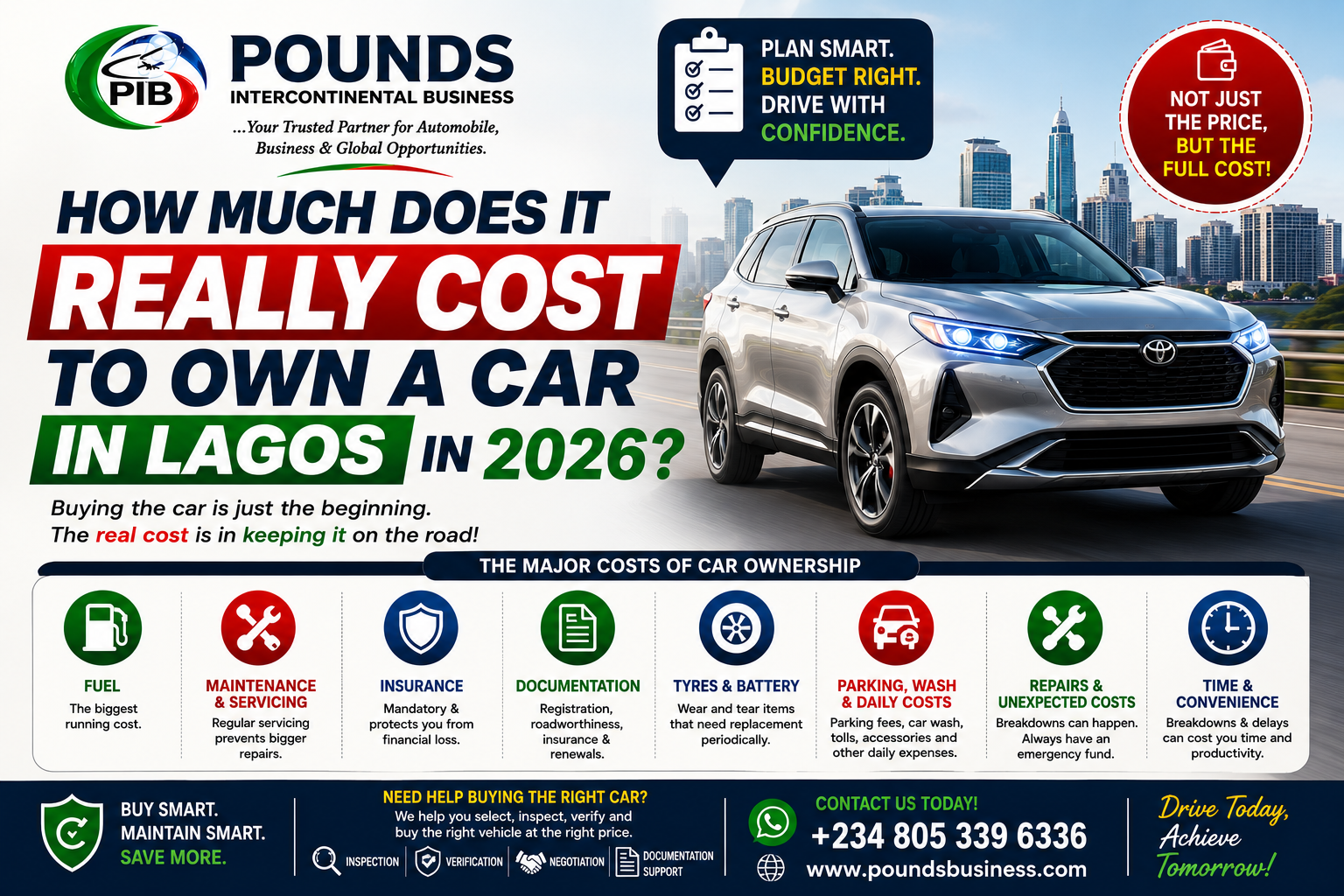
Fuel.
Maintenance.
Insurance.
Documentation.
Tyres.
Repairs.
Parking.
Car washing.
And the unexpected problems that always seem to arrive at the worst possible time.
This raises an important question:
How much does it really cost to own a car in Lagos in 2026?
The answer is more complicated than the price written on the windscreen.
A ₦10 million car does not necessarily cost only ₦10 million.
The purchase price is just the beginning.
Your real car ownership cost depends on the vehicle, how much you drive, fuel consumption, maintenance history, insurance, age, road conditions, parking arrangements and unexpected repairs.
In this guide, Pounds Intercontinental Business breaks down the major expenses Nigerian car owners should consider before buying a vehicle in Lagos.
Why the Purchase Price Is Not the Real Cost
One of the biggest mistakes prospective car buyers make is calculating only the amount required to purchase the vehicle.
For example, imagine someone has ₦12 million available and finds a car for ₦11.5 million.
The buyer may think:
“I can afford this car.”
But can they?
After purchasing the vehicle, there may still be expenses for:
- Insurance
- Documentation
- Immediate servicing
- Fuel
- Tyres
- Battery
- Repairs
- Vehicle inspection
- Parking
- Car wash
- Emergency maintenance
Suddenly, the remaining ₦500,000 may not be enough.
The better question is:
Can I afford to buy this car AND comfortably maintain it?
That is the question every serious buyer should answer before paying.
The Major Costs of Car Ownership in Lagos
Your total vehicle expenses can generally be divided into two categories.
Fixed or predictable expenses
These include:
- Insurance
- Documentation and applicable renewals
- Planned servicing
- Routine maintenance
Variable expenses
These can change significantly depending on how you use the vehicle:
- Fuel
- Repairs
- Parking
- Car wash
- Tyres
- Battery
- Traffic-related travel
- Unexpected mechanical problems
Understanding both categories gives you a much clearer picture of your car ownership budget.
1. Fuel: The Expense You Will Feel Every Week
For many Lagos motorists, fuel is one of the most noticeable running costs.
And because petrol prices can change, you should not build your annual budget around one permanent figure.
The National Bureau of Statistics maintains a monthly Premium Motor Spirit price watch, with prices reported by state. Its February 2026 data, for example, put Lagos at an average retail price of ₦966.61 per litre.
But the market subsequently moved significantly. June reports showed major Lagos outlets selling around ₦1,205–₦1,220 per litre, while July reports recorded further nationwide price increases.
Why this matters
A small change in fuel price becomes significant when multiplied by hundreds of litres every month.
How to Calculate Your Fuel Budget
Use this simple formula:
Monthly fuel cost = litres used × current price per litre
For example, if your vehicle uses approximately 150 litres per month and your actual pump price is ₦1,200 per litre:
150 × ₦1,200 = ₦180,000
That is an illustrative calculation, not a claim that ₦1,200 is today’s universal Lagos pump price.
Your actual cost depends on the station you use, current market conditions, your vehicle and how much you drive.
Your driving pattern matters
Someone who drives:
- Magboro → Ikeja → Victoria Island every weekday
- Igando – Ajah axis
will have a completely different fuel bill from someone who drives occasionally around their neighborhoods.
2. Maintenance and Servicing
A car that is properly maintained is generally easier to budget for than a vehicle that is neglected until something breaks.
Routine maintenance may include:
- Engine oil
- Oil filter
- Air filter
- Brake inspection
- Brake pads
- Coolant
- Transmission service where applicable
- Spark plugs where applicable
- Wheel alignment
- Suspension checks
- Battery checks
- General inspection
The exact maintenance schedule varies by vehicle.
Don’t wait for the car to complain.
A warning light, unusual sound or vibration should not automatically be ignored because:
“The car is still moving.”
A vehicle can continue moving while a developing problem becomes more expensive.
Why Cheap Maintenance Can Become Expensive Repairs
Consider two drivers.
Driver A
Changes oil regularly, checks tyres, services the vehicle and investigates unusual noises.
Driver B
Continues driving until something fails.
Driver B may eventually face:
- Major engine problems
- Transmission issues
- Suspension damage
- Brake problems
- Electrical faults
The lesson is simple:
Routine maintenance is an expense. Major neglect can become a much bigger expense.
3. Insurance
Insurance should be included in your ownership budget from the beginning.
Under Nigeria’s Insurance Industry Reform Act 2025, third-party motor insurance is required for the use of motor vehicles on public roads, subject to the law’s provisions.
The cost of insurance can vary depending on:
- Vehicle value
- Type of cover
- Insurer
- Vehicle use
- Risk profile
- Policy terms
Third-party vs broader cover
Third-party insurance primarily addresses liabilities to third parties covered by the policy.
Broader motor insurance products can provide additional protection depending on the policy.
Before buying insurance, understand:
- What is covered?
- What is excluded?
- What is the insured value?
- What is the excess?
- What happens after an accident?
- How do you make a claim?
NAICOM provides an online portal where consumers can check whether an insurance policy they purchased is valid.
Don’t buy insurance just because you need a certificate.
Buy a policy you understand.
4. Vehicle Documentation
Documentation is another expense that buyers sometimes forget when calculating their budget.
Depending on the vehicle and transaction, you may need to account for applicable:
- Registration
- Vehicle licence
- Roadworthiness requirements
- Insurance
- Ownership documentation
- Other regulatory requirements
The exact fees and requirements can change, so don’t rely on an old social-media post or outdated article when budgeting.
Always confirm current requirements with the appropriate authorities.
The smart approach
Before buying the vehicle, ask:
“What documentation expenses will I have immediately after purchase?”
Put those costs into your budget.
5. Tyres, Battery and Wear-and-Tear Items
These are expenses that don’t necessarily happen every month, but they can arrive together.
Tyres
Your tyres affect:
- Safety
- Braking
- Handling
- Fuel efficiency
- Ride comfort
Four tyres can represent a significant unexpected expense.
Battery
A weak battery can leave you stranded and may require replacement sooner than expected.
Brake components
Brake pads and other braking components wear with use.
Wipers and bulbs
Small items can also add up over a year.
The lesson
Don’t budget only for the things you buy every month.
Create a vehicle replacement and maintenance reserve for items that need replacement periodically.
6. Repairs and Unexpected Expenses
This is where many first-time car owners get into trouble.
You can plan your fuel.
You can plan your insurance.
You can plan your servicing.
But can you plan for:
- A damaged suspension?
- A failed alternator?
- A broken air-conditioning component?
- A transmission problem?
- A damaged tyre?
- An electrical fault?
Not completely.
That is why every car owner should have an emergency vehicle fund.
How Much Should You Keep Aside?
There is no universal amount that works for every driver.
A reasonable approach is to build a reserve based on:
- Vehicle age
- Vehicle condition
- Model
- Availability of parts
- Mileage
- Your driving frequency
- Your income
- Known maintenance history
An older vehicle with a questionable history generally deserves a larger emergency reserve than a newer, well-maintained vehicle.
7. Parking, Car Wash and Daily Running Costs
Let’s talk about the expenses many people forget.
Parking
Depending on where you work, shop, live or attend events, parking can become a regular expense.
Car wash
Washing a vehicle regularly costs money if you don’t do it yourself.
Tolls and road-related expenses
Depending on your routes and destinations, you may encounter applicable road-use expenses.
Accessories
Car owners often spend money on:
- Phone holders
- Chargers
- Floor mats
- Dash cameras
- Air fresheners
- Sunshades
- Seat covers
- Security devices
Individually, these may seem small.
Together, they become part of the ownership budget.
8. The Hidden Cost: Your Time
This is rarely included in financial calculations.
But time is money.
How much time do you spend:
- Looking for fuel?
- Taking the car for servicing?
- Visiting mechanics?
- Washing the vehicle?
- Searching for spare parts?
- Dealing with breakdowns?
- Looking for parking?
A reliable vehicle can save more than money.
It can save time, stress and productivity.
That is one reason why buying the cheapest available vehicle is not always the smartest financial decision.
New Car vs Used Car: Which Costs Less?
This is a question many Nigerians ask.
The answer depends on the specific vehicle.
A new car usually offers:
- Newer components
- Less wear
- Greater predictability
- Potential manufacturer support depending on the vehicle
But it can require a larger initial investment and may depreciate quickly.
A used vehicle may offer:
- Lower purchase price
- More affordable entry into vehicle ownership
- Greater variety within a particular budget
But the buyer needs to pay closer attention to:
- Previous ownership
- Accident history
- Mileage
- Maintenance
- Mechanical condition
- Documentation
The cheapest purchase is not automatically the cheapest ownership option.
This is why your car ownership decision should consider the full picture.
A Simple Lagos Car Ownership Budget
Let’s create an illustrative example.
Suppose a driver owns a medium-sized petrol vehicle and uses it regularly for work and personal travel.
Assume:
Fuel: ₦180,000/month
Routine maintenance reserve: ₦40,000/month
Insurance reserve: ₦15,000/month
Documentation reserve: ₦10,000/month
Tyre/battery reserve: ₦15,000/month
Emergency repair reserve: ₦30,000/month
Parking/car wash/miscellaneous: ₦25,000/month
Illustrative monthly running budget:
₦315,000
Again, this is not a universal Lagos car cost.
It is a budgeting example showing why you should calculate your own numbers.
A driver who travels less may spend much less on fuel.
An SUV may consume more fuel.
An older vehicle may require more repairs.
A newer vehicle may have different maintenance needs.
Your actual budget should therefore be based on your own vehicle and lifestyle.
How to Calculate Your Own Car Budget
Use this formula:
Monthly Car Budget
Fuel
Maintenance
Insurance
Documentation
Tyres/Battery
Repairs
Parking
Other running costs
=
Estimated Monthly Car Cost
Then multiply the monthly figure by 12.
But don’t stop there.
Add a separate emergency reserve.
The 50/30/20 Rule Doesn’t Automatically Work for Cars
Some people try to apply a general personal-finance rule to vehicle ownership.
The problem is that vehicle expenses can vary dramatically.
A person earning ₦500,000 monthly and driving a fuel-efficient compact car may have a very different situation from someone earning ₦2 million monthly while driving a large SUV extensively.
Your vehicle should fit your financial reality.
Before buying, ask:
Can my income comfortably support this vehicle?
Not:
Can I somehow raise the purchase price?
Those are two very different questions.
10 Questions to Ask Before Buying a Car
1. How much will I spend on fuel every month?
Calculate based on your actual driving.
2. How much does routine servicing cost?
Ask for the expected service schedule.
3. How easy are spare parts to find?
A vehicle with difficult-to-source parts can become frustrating to maintain.
4. How expensive are the tyres?
Check the tyre size and replacement cost.
5. How much will insurance cost?
Get an actual quotation.
6. What documentation costs will I face?
Verify the current applicable requirements.
7. What is the vehicle’s maintenance history?
Don’t buy blindly.
8. Has the car been accidented?
Investigate properly.
9. What is the resale value?
Think about your exit strategy.
10. Can I afford unexpected repairs?
If the answer is no, reconsider the vehicle.
5 Ways to Reduce Your Car Expenses in Lagos
1. Choose the right vehicle
Don’t buy a vehicle simply because it looks impressive.
Choose one that matches your:
- Income
- Family size
- Driving pattern
- Roads
- Business needs
- Maintenance capacity
2. Maintain the vehicle regularly
Preventive maintenance can help you identify problems earlier.
3. Monitor your fuel consumption
Track how much you spend each month.
If your fuel bill suddenly rises, investigate.
4. Compare maintenance options
Don’t automatically use the first available service provider.
Compare expertise, quality, parts and pricing.
5. Create a vehicle emergency fund
Even a small amount saved consistently can reduce the financial shock of an unexpected repair.
The Biggest Mistake: Buying a Car That Impresses People but Stresses Your Finances
Imagine buying an expensive SUV because you want to look successful.
The vehicle is impressive.
People admire it.
But every month you struggle with:
- Fuel
- Maintenance
- Insurance
- Repairs
- Parking
- Other bills
Eventually, the vehicle stops feeling like an achievement.
It becomes a burden.
A smarter approach
Buy the car that gives you:
Reliability + affordability + suitability + value
not simply the car that attracts the most attention.
When Should You Consider Professional Car-Buying Assistance?
Professional guidance can be especially useful when:
- You are buying your first car.
- You are spending a large amount of money.
- You are buying a used vehicle.
- You don’t understand vehicle mechanics.
- You are unsure about documentation.
- You are buying from an unfamiliar seller.
- You are comparing several vehicle options.
- You don’t know the true cost of ownership.
The objective isn’t to make the decision for you.
It is to help you make a better-informed decision before committing your money.
How Pounds Business Can Help
At Pounds Intercontinental Business, we believe that buying a vehicle should be about more than finding a beautiful car.
It should be about finding the right vehicle for your needs and financial capacity.
Our automobile-related assistance can include areas such as:
- Vehicle selection
- Vehicle inspection
- Vehicle verification
- Documentation guidance
- Purchase assistance
- Negotiation support
- Automobile advisory services
Planning to buy a car?
Don’t ask only:
“How much is the car?”
Ask:
“How much will this car cost me to own?”
That question could save you from making an expensive mistake.
📞 Call/WhatsApp: +234 805 339 6336
Pounds Intercontinental Business
Your Trusted Partner for Automobile, Business & Global Opportunities.