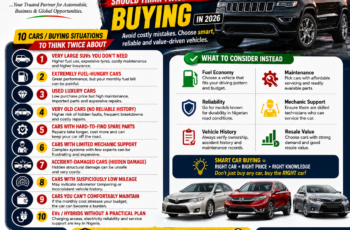
15 Things to Check Before Buying a Used Car in Nigeria 2026
15 Things to Check Before Buying a Used Car in Nigeria 2026 | By Pounds Intercontinental Business
Buying a used car in Nigeria can either be one of the smartest financial decisions you make or one of the most expensive mistakes you ever regret.
A vehicle may look spotless on the outside. The interior may smell fresh. The engine may sound smooth during a short test drive. The seller may even assure you that the car is “tokunbo,” accident-free and in perfect condition.
But appearances can be deceiving.
Before you transfer your money, there are important things you need to check—mechanical condition, vehicle history, ownership, documentation, accident history, chassis/VIN information and much more.
The biggest mistake many buyers make is falling in love with the car before investigating the car.
If you are planning to buy a used car in Nigeria in 2026, this checklist can help you make a smarter decision.
Why You Should Never Rush Into Buying a Used Car
The pressure to buy quickly can work against you.
A seller may tell you:
“Someone else is coming to inspect it.”
Or:
“If you don’t pay today, I’ll sell it to another person.”
Don’t allow pressure to replace proper due diligence.
A good vehicle should survive a proper inspection.
If a seller becomes uncomfortable because you want to inspect the vehicle, verify its documents or take it to a qualified mechanic, that should be a warning sign.
Remember:
You are not buying the seller’s story. You are buying the vehicle.
15 Things to Check Before Buying a Used Car in Nigeria
1. Check the Vehicle’s VIN and Chassis Number
The Vehicle Identification Number (VIN) is one of the most important identifiers of a vehicle.
Don’t simply look at the VIN on one location and assume everything is fine.
Compare the vehicle identification information with the available documentation and registration information.
FRSC’s vehicle-registration system includes vehicle identifiers such as the chassis number, engine number, vehicle make, model, year of manufacture and other information.
Why this matters
A discrepancy between the vehicle and its documents could indicate a serious problem.
Never ignore a VIN/chassis-number mismatch.
2. Verify the Vehicle Ownership
This is one area where buyers should be particularly careful.
Before completing a purchase, establish who legally owns the vehicle and whether the seller has the right to sell it.
FRSC currently provides a Proof of Ownership Verification platform designed to help vehicle owners verify ownership information.
Ask questions such as:
- Who is the registered owner?
- Does the seller have evidence of ownership?
- Do the names and vehicle details correspond?
- Is there any outstanding ownership issue?
- Can the ownership information be properly verified?
Don’t allow a seller’s confidence to replace documentation.
3. Inspect the Engine Properly
Never buy a used car simply because the engine “sounds good.”
A proper inspection should consider:
- Engine leaks
- Unusual smoke
- Oil condition
- Coolant condition
- Engine noise
- Overheating
- Warning lights
- Signs of previous repairs
- Possible oil or coolant contamination
If you are not mechanically experienced, bring someone who is.
A beautiful car with a problematic engine can quickly turn into a financial nightmare.
4. Check the Transmission
Transmission repairs can be expensive, depending on the vehicle and the nature of the fault.
During a test drive, pay attention to:
- Delayed engagement
- Hard shifting
- Jerking
- Unusual noises
- Slipping
- Difficulty selecting gears
- Warning lights
Don’t allow a seller to dismiss unusual behaviour by saying:
“That’s normal for this model.”
Get an independent opinion.
5. Examine the Body for Signs of Accident Repairs
A shiny body does not automatically mean the car has never been involved in an accident.
Look carefully for:
- Uneven panel gaps
- Different shades of paint
- Overspray
- Welding marks
- Replaced panels
- Poorly aligned doors
- Unusual body repairs
- Signs of structural repair
A vehicle can be repaired beautifully and still require careful investigation.
The goal isn’t necessarily to reject every previously repaired vehicle.
The goal is to know what you are buying before you pay.
6. Inspect the Interior—But Don’t Be Fooled by It
A freshly detailed interior can make an old vehicle look almost new.
Check:
- Steering-wheel wear
- Pedal wear
- Seat condition
- Dashboard condition
- Electrical switches
- Air conditioning
- Windows
- Central locking
- Infotainment
- Instrument cluster
- Warning lights
Compare the interior wear with the claimed mileage.
For example, extremely worn pedals and steering-wheel surfaces may deserve further investigation if the vehicle is being presented as having unusually low mileage.
7. VERIFY THE VEHICLE HISTORY — THIS COULD SAVE YOU MILLIONS
This is the one I want every Nigerian car buyer to take seriously.
Do not buy a used vehicle based only on what the seller tells you about its history.
Find out as much as reasonably possible about:
- Previous ownership
- Accident history
- Importation history where applicable
- Mileage history
- Major repairs
- Flood or water damage
- Previous use
- Registration information
- Ownership status
A vehicle that looks perfect today may have a history the seller has not disclosed.
And discovering that history after payment is exactly what you want to avoid.
Where appropriate, use official verification channels and qualified professionals rather than relying on screenshots, verbal assurances or social-media claims.
8. Check the Odometer—But Don’t Trust It Blindly
Mileage can influence how buyers perceive a vehicle.
But the number displayed on the dashboard should not be treated as unquestionable proof of the vehicle’s true history.
Look for consistency between:
- Odometer reading
- Interior wear
- Service records
- Tyre condition
- Vehicle history
- Previous maintenance records
A suspiciously low mileage combined with heavy wear should make you investigate further.
9. Inspect the Suspension
Nigeria’s roads can be demanding on vehicles.
During inspection and test driving, pay attention to:
- Knocking sounds
- Excessive bouncing
- Uneven tyre wear
- Vehicle pulling to one side
- Steering vibration
- Unusual suspension noise
A suspension problem may not immediately make the car undrivable, but ignoring it can lead to additional expenses.
10. Check the Tyres
Tyres are often overlooked because they appear to be a relatively small part of the purchase.
But replacing four tyres can become an immediate expense after buying a vehicle.
Check:
- Tread depth
- Uneven wear
- Cracks
- Bulges
- Age
- Matching tyres
- Spare tyre condition
Don’t forget to inspect the spare tyre and the tools needed to change it.
11. Test the Braking System
Never compromise on brakes.
During a safe test drive, pay attention to:
- Brake response
- Pulling to one side
- Vibrations
- Grinding sounds
- Warning lights
- Unusual pedal behaviour
If you notice anything suspicious, have the braking system professionally inspected before buying.
12. Test the Electrical Systems
Modern vehicles contain numerous electrical components.
Test as many functions as possible:
- Headlights
- Brake lights
- Indicators
- Reverse lights
- Horn
- Air conditioning
- Power windows
- Central locking
- Wipers
- Dashboard
- Audio system
- Cameras and sensors where fitted
One small electrical fault can sometimes reveal a much larger problem.
13. Check the Vehicle’s Documents
Don’t wait until after you have paid before asking questions about documentation.
Depending on the vehicle and transaction, relevant documentation may include registration and ownership records, insurance and other applicable vehicle documents.
FRSC’s official materials describe vehicle-registration processes involving verification, physical inspection and documentation such as proof of ownership, vehicle licence, roadworthiness documentation and insurance.
Because requirements and processes can change, always verify current requirements through the appropriate government channels before completing your transaction.
Never rely solely on an old article, social-media post or verbal advice for current regulatory requirements.
14. Take the Car for an Independent Inspection
This is one of the smartest things you can do.
The seller may have serviced the vehicle.
The seller may know a mechanic.
The seller may even offer to take you to their “trusted” workshop.
But remember:
The person selling you the car should not be the only person determining whether the car is good enough for you to buy.
Use an independent, qualified mechanic or vehicle inspection professional.
The inspection should cover the major mechanical, electrical, structural and documentation concerns relevant to the vehicle.
15. Calculate the REAL Cost Before You Buy
This is where many buyers get caught.
Suppose you buy a car at an attractive price.
Immediately afterwards, you discover that you need:
- New tyres
- Major servicing
- Suspension repairs
- Battery replacement
- Documentation updates
- Insurance
- Other repairs
Suddenly, the “cheap” car isn’t cheap anymore.
Before buying, calculate:
Purchase price + immediate repairs + documentation + insurance + maintenance + other expected costs = REAL COST OF OWNERSHIP
That is the figure you should compare with other vehicles.
🚨 7 RED FLAGS THAT SHOULD MAKE YOU STOP
Be extremely cautious when you encounter situations such as:
🚩 1. The seller refuses independent inspection
🚩 2. Vehicle identification details don’t match
🚩 3. Ownership information cannot be properly established
🚩 4. The seller is rushing you to pay
🚩 5. The price appears unrealistically attractive
🚩 6. The vehicle has unexplained structural or mechanical issues
🚩 7. The seller cannot provide convincing answers about the vehicle’s history
One red flag doesn’t automatically prove fraud.
But multiple unexplained red flags should make you seriously reconsider the transaction.
💡 THE GOLDEN RULE OF USED-CAR BUYING
Here’s the rule every buyer should remember:
Never fall in love with a car before you fall in love with the facts.
The colour can be changed.
The rims can be changed.
The leather can be changed.
The entertainment system can be upgraded.
But a major hidden mechanical, structural, ownership or documentation problem can cost you significantly more than you expected.
🧮 BUYER’S QUICK CHECKLIST
Before paying for a used car, ask yourself:
☐ Have I inspected the engine?
☐ Have I checked the transmission?
☐ Have I inspected the body for accident repairs?
☐ Have I checked the VIN/chassis number?
☐ Have I investigated the vehicle’s history?
☐ Have I verified ownership?
☐ Have I checked the documents?
☐ Have I tested the brakes?
☐ Have I checked the suspension?
☐ Have I inspected the tyres?
☐ Have I tested the electrical systems?
☐ Have I taken the car for an independent inspection?
☐ Have I calculated the actual cost of owning the vehicle?
☐ Have I checked whether the seller’s claims can be independently verified?
☐ Am I buying because the vehicle is genuinely suitable—or because I’m afraid someone else will buy it first?
If you cannot confidently answer these questions, slow down.
🚘 DON’T JUST BUY A CAR. BUY WITH CONFIDENCE.
At Pounds Intercontinental Business, our goal is to help prospective vehicle buyers make informed decisions rather than rush into expensive mistakes.
From identifying suitable vehicles to helping with inspection, verification, negotiation and purchase guidance, professional assistance can give buyers another layer of confidence.
Our previous client-focused SUV buying guide demonstrates the same approach: understanding a buyer’s needs, evaluating options, verifying vehicle history, negotiating and supporting the purchase process.
Thinking about buying a car?
Don’t pay first and investigate later.
Contact Pounds Intercontinental Business for professional guidance and assistance with your vehicle purchase.
📞 Call/WhatsApp: +234 805 339 6336
📧 Email: poundsintercontinentalbusiness@gmail.com
🌐 Website: www.poundsbusiness.com
Your dream car should give you peace of mind—not years of regret.